
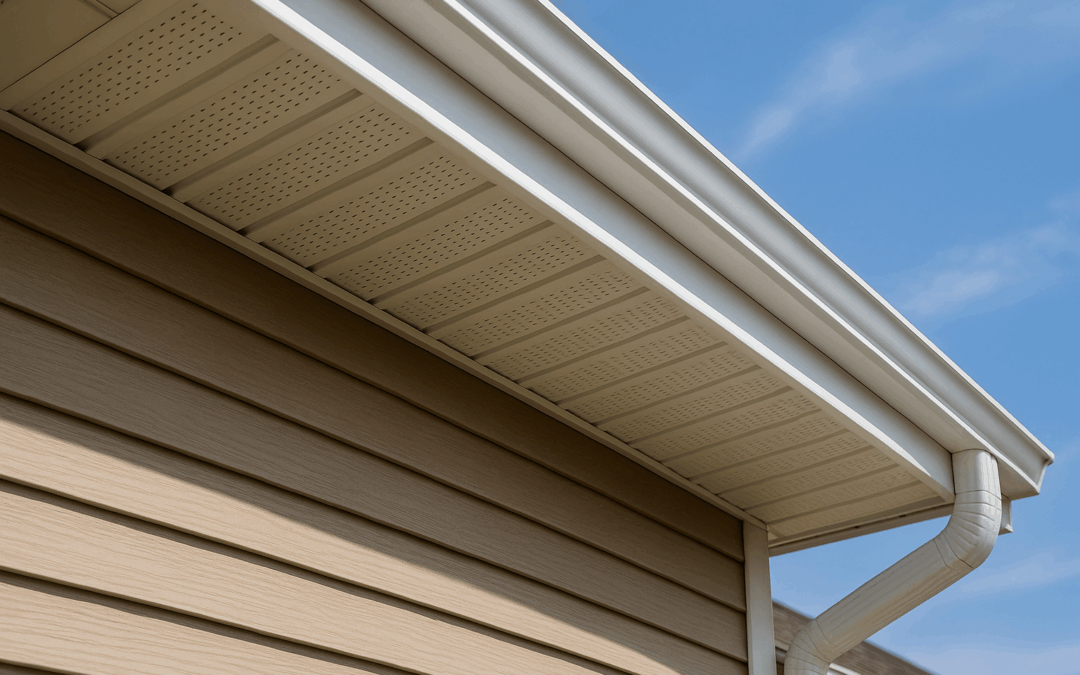
When Nashville and Knoxville, Tennessee homeowners face soffit replacement decisions—whether due to deteriorated wood soffit, a roofline renovation, or new construction—vinyl soffit is one of the most commonly considered material options. Installed on the underside of roof overhangs between the exterior wall and fascia board, soffit performs critical functions including attic ventilation and pest exclusion while contributing to the visual character of the roofline. Vinyl soffit brings a set of material properties that make it a relevant choice for Tennessee’s specific climate conditions. Big Orange Gutters believes that homeowners throughout Nashville and Knoxville benefit from a detailed, informational understanding of vinyl soffit—what it is, how it is installed, what advantages it provides in Tennessee’s environment, and what practical considerations matter when evaluating it.
Defining Vinyl Soffit
Vinyl soffit consists of panels manufactured from polyvinyl chloride (PVC) designed for installation on the underside of roof overhangs—the horizontal surface visible beneath the eaves when standing near the exterior wall. Available in solid panels for areas where ventilation is not required and perforated or vented panel configurations that allow air movement into the attic space below, vinyl soffit panels interlock along their edges and install into channel trim pieces secured to the wall face and fascia board.
The material’s color is integrated throughout the PVC during manufacturing, meaning the appearance is consistent through the panel depth rather than being a surface coating applied over a differently colored substrate. This manufacturing approach means surface scratches do not expose a contrasting color and the panels do not require field painting to maintain their appearance. Vinyl soffit is produced in numerous profiles—smooth face, beaded, and woodgrain textures among them—and in a variety of colors, most commonly whites and neutral tones designed to coordinate with complementary vinyl exterior products.
The performance advantages that make vinyl soffit a relevant consideration in Tennessee’s climate stem from its fundamental material properties: it does not absorb moisture, it does not provide nutritional substrate for biological deterioration, and it does not require periodic surface treatment to maintain moisture resistance.
Tennessee’s Climate and Why Soffit Material Matters
Both Nashville and Knoxville experience Tennessee’s humid subtropical climate, receiving approximately 47 to 48 inches of annual precipitation alongside high summer humidity, warm temperatures that support biological activity through most of the year, UV-intense summers, and active spring storm seasons. These conditions create a demanding environment for exterior building materials, and soffit—positioned beneath the roof overhang where moisture from gutter overflow, condensation, and wind-driven rain regularly reaches—faces sustained weathering stress throughout the year.
Wood soffit in Tennessee’s climate faces an accelerated deterioration cycle driven by the combination of frequent moisture exposure, slow drying in high humidity, warm temperatures supporting fungal activity, UV paint degradation during long hot summers, and the pest activity that Tennessee’s climate supports. Carpenter bees are common throughout Tennessee and actively bore into wood soffit panels, creating structural damage and moisture entry points. The result is a material requiring periodic repainting, susceptible to rot within years without attentive moisture management, and vulnerable to pest damage that vinyl’s physical properties prevent entirely.
Vinyl soffit’s moisture resistance and biological inertness address these specific deterioration mechanisms directly, which is why it has become widely used in Tennessee residential construction and renovation.
Vinyl Soffit Installation Process
Installation of vinyl soffit follows a systematic sequence that begins with preparing the installation area. When replacing existing wood soffit, the deteriorated panels are removed and the underlying framing—nailer boards or lookout framing—is inspected and repaired as needed before new installation begins. Addressing any moisture damage, pest damage, or structural issues in the framing before covering them with new soffit is essential for lasting results.
J-channel or F-channel trim pieces are installed along the wall face at the inner soffit edge and along the fascia board at the outer soffit edge. These channels serve as receiving tracks for the soffit panel edges, holding panels securely in position while accommodating the thermal expansion and contraction that vinyl experiences with temperature changes. Proper channel installation—level, plumb, and positioned to hold panels without binding—is foundational to a quality installation outcome.
Soffit panels are measured and cut to the appropriate width—the distance spanning from wall channel to fascia channel—and inserted into the channels, interlocking with adjacent panels as installation progresses along the soffit run. Face-nailing through the panel’s nailing hem secures each panel to the soffit framing, with the adjacent interlocking panel covering the fastener to produce a clean finished surface. Panels must be installed with slight looseness in the channels to allow thermal movement without buckling.
Planning the distribution of vented versus solid panels requires attention during installation. Sufficient net free ventilation area must be achieved to meet attic ventilation requirements for the specific attic volume. Knoxville-area homes, where mountain climate humidity creates more demanding attic moisture management needs, may require careful ventilation planning to ensure adequate airflow. Nashville homes in dense urban neighborhoods surrounded by mature tree canopy may have specific soffit access considerations affecting installation approach.
Benefits of Vinyl Soffit in Tennessee’s Environment
Resistance to Moisture Damage: PVC does not absorb water. This fundamental property eliminates the moisture absorption and retention that makes wood soffit vulnerable to rot in Tennessee’s frequently wet, high-humidity climate. Vinyl panels shed water from their surface without the biological deterioration consequences that moisture absorption causes in wood.
Elimination of Paint Maintenance: Vinyl soffit’s factory-integrated color requires no field painting for moisture protection or appearance maintenance. In Nashville and Knoxville, where wood soffit painting must be repeated every few years to remain effective against Tennessee’s climate, this maintenance elimination represents a meaningful long-term practical advantage.
Resistance to Carpenter Bees and Insects: Vinyl’s physical hardness and chemical composition make it unsuitable for carpenter bee boring activity. Carpenter bees that readily excavate wood soffit panels cannot damage vinyl panels, eliminating a significant deterioration pathway that Tennessee’s warm climate makes persistent.
Mold and Mildew Resistance: While vinyl surfaces can accumulate surface mold and mildew in humid conditions, the material itself does not support biological growth within its structure the way wood does. Surface biological growth is addressable through cleaning without the structural implications that internal wood rot creates.
Consistent and Measurable Ventilation: Factory-perforated vinyl vented panels provide consistent net free ventilation area that supports accurate attic ventilation design. Consistent ventilation performance benefits roof longevity and household energy efficiency in Tennessee’s hot summers and humid winters.
Long Service Life with Minimal Maintenance: The combination of moisture resistance, biological inertness, color integration, and UV stability produces a soffit material with a service life that significantly exceeds painted wood soffit under Tennessee’s demanding climate conditions, with substantially lower maintenance requirements throughout that service life.
Practical Considerations for Homeowners
Vinyl soffit performs best when installed correctly by experienced installers who understand thermal expansion requirements, ventilation planning, and proper channel integration. Installations that bind panels without allowing expansion or that improperly integrate channels at corners and transitions may develop buckling, gaps, or appearance problems that correct installation avoids.
Impact damage from severe hail events—which both Nashville and Knoxville can experience during active spring storm seasons—can crack or break vinyl soffit panels. Panel replacement following significant hail damage requires matching the existing product profile and color, which can be challenging if the original product line has been discontinued.
For historically or architecturally significant homes in Nashville’s or Knoxville’s historic neighborhoods, vinyl soffit may not be appropriate from a preservation standpoint, as architectural review guidelines sometimes require maintenance of original materials. Homeowners in historic districts should understand applicable guidelines before selecting vinyl soffit for roofline renovation.
Conclusion
Vinyl soffit is a widely used and well-suited exterior material for Nashville and Knoxville, Tennessee homes, offering performance characteristics that directly address the moisture, biological activity, pest, and maintenance challenges that Tennessee’s humid subtropical climate creates for roofline exterior materials. Big Orange Gutters recognizes that Tennessee homeowners benefit from understanding what vinyl soffit is, how it is correctly installed, what genuine advantages it provides in Tennessee’s specific environment, and what practical considerations affect its long-term performance. For homes throughout Nashville and Knoxville facing the combination of substantial annual rainfall, high humidity, warm temperatures, UV intensity, and active pest populations that define Tennessee’s climate, vinyl soffit’s material properties make it a product worth understanding thoroughly when roofline decisions arise.