
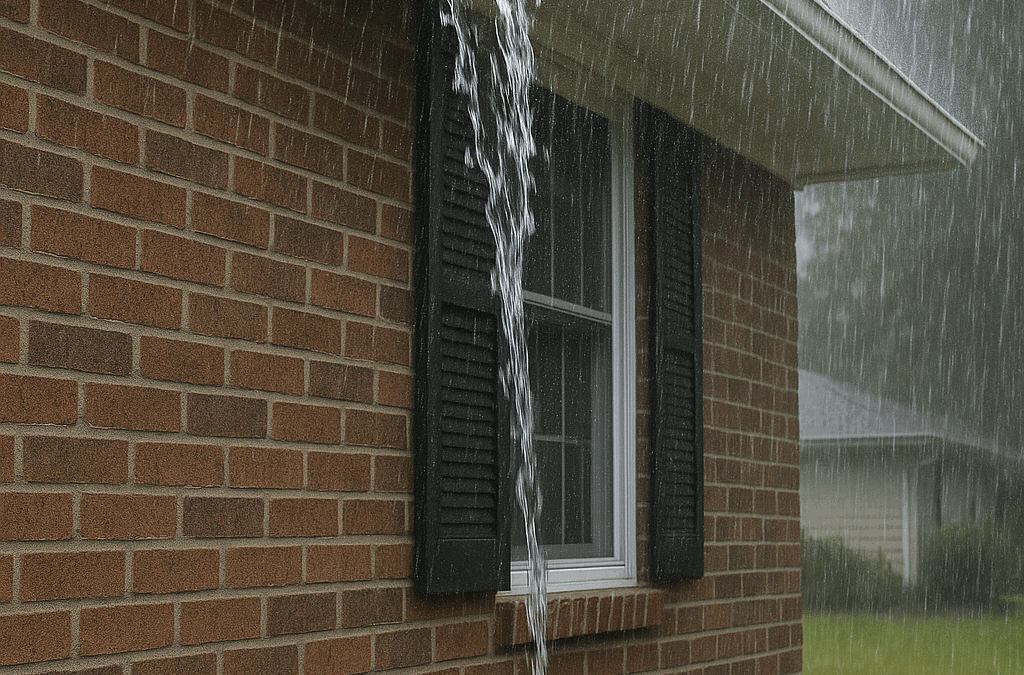
After an autumn storm, a pool of water may remain below a downspout even though the gutter has stopped dripping. On another day, the same location may stay nearly dry. This difference does not necessarily mean the downspout worked in one storm and failed in the other.
The amount and pace of rain, the condition of the soil, the shape of the ground, and the route at the outlet all influence what homeowners see. Nashville and Knoxville properties also differ in terrain and landscaping, so the discharge pattern should be read in the context of the individual site.
Roof Water Reaches the Ground at a Concentrated Point
Gutters collect water from an area much larger than the patch of ground under a downspout. The outlet therefore delivers runoff at a concentrated rate. Even a functioning route can temporarily release water faster than nearby soil accepts it.
A visible pool can indicate that the receiving area is holding water, not necessarily that water failed to travel through the downspout. Watching the outlet during rain helps establish the sequence. A steady discharge followed by surface pooling differs from little outlet flow combined with water spilling over the gutter above.
Storm Duration Matters as Much as Intensity
A short downpour and a long, moderate rain can produce different results. Intense rain increases the amount reaching the outlet at one time. Extended rain can gradually saturate the yard until infiltration slows.
The ground may absorb the first part of a storm and puddle later. That timing is useful. If water begins collecting only after hours of rain, saturation may be part of the pattern. If a pool forms immediately around one small depression, local surface shape may be more influential.
Neither clue proves a single cause. Compaction, roots, mulch, pavement, and previous landscape work can change how water moves from one property to the next.
Nashville and Knoxville Terrain Can Produce Different Paths
Some homes sit on noticeable slopes, while others have nearly level yards or small flat areas near the foundation. In either setting, water follows the immediate grade after it leaves the downspout.
A slight hollow can collect runoff before it reaches the broader slope. Landscape borders or raised walkways can act like shallow dams. On a hillside, fast surface flow may erode a narrow path rather than create a round puddle.
Look for displaced mulch, sediment lines, flattened vegetation, or repeated damp streaks. These features can show direction, although they do not measure the capacity of the gutter system.
Leaves May Change the Outlet Pattern
Late-season leaves can affect more than the roofline. Material gathered at the bottom of a downspout may deflect the stream or slow its spread across the ground. A mat of wet leaves can cover a drain opening or hold moisture after the surrounding surface begins to dry.
Debris may also be present higher in the gutter-and-downspout route. Gutter and downspout cleaning concerns that internal material. It does not alter the soil, grading, or hard surfaces receiving the discharge.
Compare clues above and below. Roofline overflow, weak outlet flow, and water appearing at a connection may suggest an upstream restriction. Strong discharge with no visible overflow, followed by ground-level pooling, describes a different pattern.
Open Outlets and Buried Routes Behave Differently
An open downspout releases water where its path can be observed. Some outlets instead enter a pipe or opening near ground level. That buried route may carry water elsewhere, but its layout cannot be confirmed by looking at the gutter.
Water rising around such a connection may involve the separate ground-level route. Avoid pulling apart fittings during a storm or assuming the pipe’s destination. A buried connection and the downspout above it form a continuous water path, but each has different surroundings.
A Ground-Level Observation Routine
Choose a sheltered location with a clear view of both the roofline and outlet. During light rain, note whether water exits steadily and whether the gutter spills over. Repeat the observation during a stronger event if conditions are safe.
Do not stand in moving water, walk on slick slopes, or observe outdoors during lightning. A zoomed video can capture the stream and puddle without requiring close access.
After rainfall, mark the approximate edge of the wet area in a photo. Note how long it takes to shrink and whether water moves toward a walkway, planting bed, or lower part of the yard. Several observations are more useful than testing the area with a large amount of added water.
Interpreting the Puddle Without Jumping to a Conclusion
A puddle near a Nashville or Knoxville downspout may result from concentrated runoff, saturated ground, a shallow depression, debris at the outlet, or a separate buried connection. Multiple factors may overlap during one storm.
The clearest record follows the water in order: roofline behavior, movement through the downspout, discharge at the bottom, travel across the surface, and drying afterward. That sequence can help homeowners distinguish a gutter-flow observation from a ground-drainage observation without assuming that one visible pool explains the entire system.