
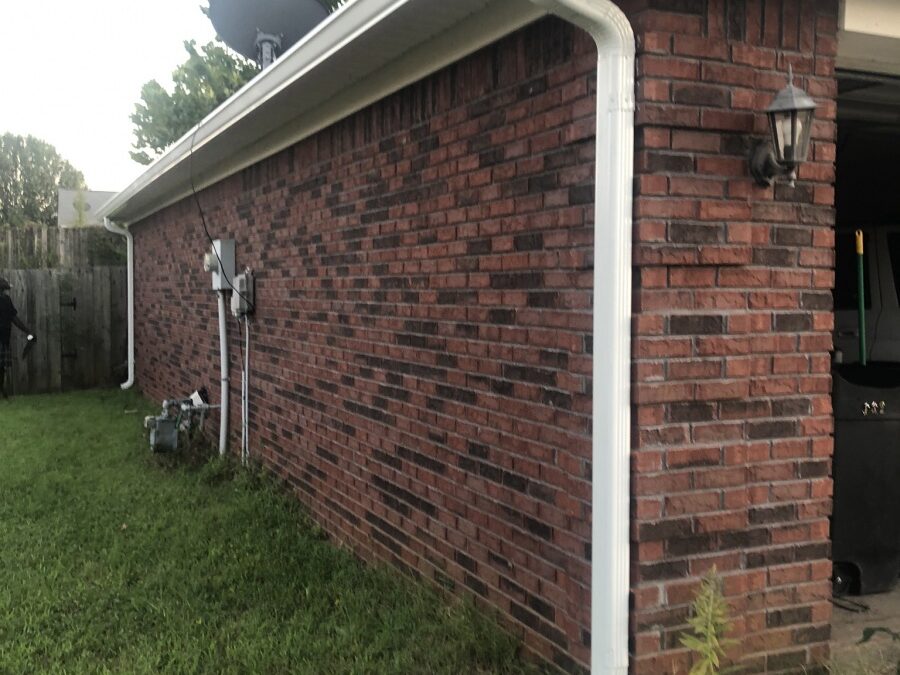
A downspout can turn an ordinary rain into a surprising amount of noise. Nashville and Knoxville homeowners may hear rushing water, hollow tapping, gurgling, vibration, or a slow drip that continues after the clouds pass. Some sounds are normal consequences of moving roof runoff, while others provide useful clues about debris, airflow, pipe connections, or the discharge area.
Listening is not a substitute for inspecting the system, but it can help identify when a sound occurs and which part of the drainage path may be involved.
Water Changes Speed Inside a Downspout
Runoff enters a gutter across the roof edge and then concentrates at the downspout outlet. It accelerates through the vertical section, changes direction at elbows, and meets a different surface or extension at ground level.
Those transitions create sound. Thin metal carries vibration readily, and attachment straps can transfer it to siding or framing. A pipe beside a quiet room may therefore sound more dramatic inside than it does outdoors.
Rainfall intensity matters as well. Tennessee thunderstorms can deliver fast bursts of water, while a gentle fall rain produces a lower, steadier flow. The same downspout may sound very different under those two conditions.
Rushing Water May Be Normal
A smooth rushing noise that rises and falls with the rain often reflects ordinary drainage. It may be louder where an upper roof, large roof plane, or valley sends substantial runoff into one gutter section.
The most useful comparison is the downspout’s own history. If it produces a consistent sound and steady discharge during similar storms, that pattern may be typical. A sudden change in tone, rhythm, or volume can provide more information than loudness alone.
Nashville and Knoxville homes vary in roof area and topography, so two neighboring systems may not sound alike even during the same weather.
Gurgling Can Develop Around a Partial Restriction
Air must move as water travels through a downspout. Leaves, pine needles, sediment, or a small object can narrow the passage and cause air and water to alternate through the remaining space. The result may sound like bubbling or gurgling.
This can occur at the upper outlet, in an elbow, or where the bottom connects to an extension or underground drain. The pipe may continue producing water, but the output can arrive in uneven surges.
If gurgling accompanies overflow at the gutter, a restriction somewhere below the overflow point is one possible explanation. Gutter size, roof runoff volume, and pitch can create similar symptoms, so sound alone does not identify a single cause.
Tapping May Be Debris in Motion
Hard material creates brief, recognizable sounds inside metal. Acorns, seed pods, small stones, and roof granules may tap or rattle while falling through a downspout. A twig lodged at a bend can move repeatedly as water passes.
This pattern may become more common during the Tennessee fall. Hardwood debris affects many Nashville neighborhoods, while wooded Knoxville properties may also collect needles and small branches.
One short burst of tapping may simply be material passing through. Repeated noise from the same spot can indicate that something is moving without fully exiting.
Dry-Weather Rattling Suggests a Different Source
Not every downspout sound is caused by water. Wind may vibrate a loose strap, shift an extension, or move one pipe section against another. A small gap between the downspout and siding can create tapping during gusts.
Timing helps separate the possibilities. Noise limited to rainfall may involve flow or debris. Rattling that also appears on dry, windy days is more consistent with movement of the downspout or its hardware.
Homeowners can watch from the ground to see whether the pipe shifts. A visible gap at a joint or missing fastener adds context without requiring ladder access.
Hollow Knocks Often Occur at Bends
When a strong stream hits the inside of an elbow, the impact can create a hollow knock. An abrupt roof runoff surge may make the first sound louder than the flow that follows.
Pipe shape affects this. Rectangular downspouts, round pipes, offset sections, and multi-elbow routes direct water differently. A bend close to a wall can transfer the sound into the building.
If knocking is paired with visible shaking or joint separation, the movement is more significant than the sound by itself.
Why Dripping Continues After the Storm
Water may remain in a gutter low spot, cling to corrugated surfaces, or collect along an elbow seam. These small amounts can release gradually after the main flow has ended.
A regular drip heard inside the pipe may simply be water falling from one interior surface to another. Drips appearing outside a connection may leave wet streaks or darken the wall below. Persistent water can also come from a gutter section that is draining more slowly than the rest.
Checking whether the sound stops after several minutes or continues much longer can help define the pattern.
The Outlet Area Has Its Own Sound
At ground level, water may strike concrete, gravel, a splash block, a corrugated extension, or standing water. Each creates a different tone. A flexible extension can pop or shift as it fills, while a pool near the outlet may produce louder splashing.
Homeowners can observe whether water has a visible route away from the wall. Displaced mulch, washed soil, or a disconnected extension may explain why the base sounds different than it did previously.
A Safe Way to Document the Noise
During moderate rain, homeowners can remain on the ground and record:
- Where the noise is loudest
- Whether it is steady, rhythmic, or random
- Whether the downspout moves
- How the discharge looks at the bottom
- Whether the gutter overflows above
- How long dripping continues afterward
- Whether the behavior changes in heavier rain
Wet roofs and ladders add unnecessary risk during a storm. A ground-level video can capture the sound, rainfall intensity, and discharge pattern for later comparison.
Reading Downspout Sounds in Nashville and Knoxville
Downspout noise is often a result of water moving through metal, but changes in that noise can reveal useful patterns. Gurgling may accompany restricted airflow, tapping can come from debris, rattling may involve loose components, and post-rain dripping can reflect retained water.
The clearest interpretation combines sound with visible behavior. By watching for overflow, irregular discharge, movement, and recurring noise, Nashville and Knoxville homeowners can better understand how their gutter system responds to Tennessee rain.