
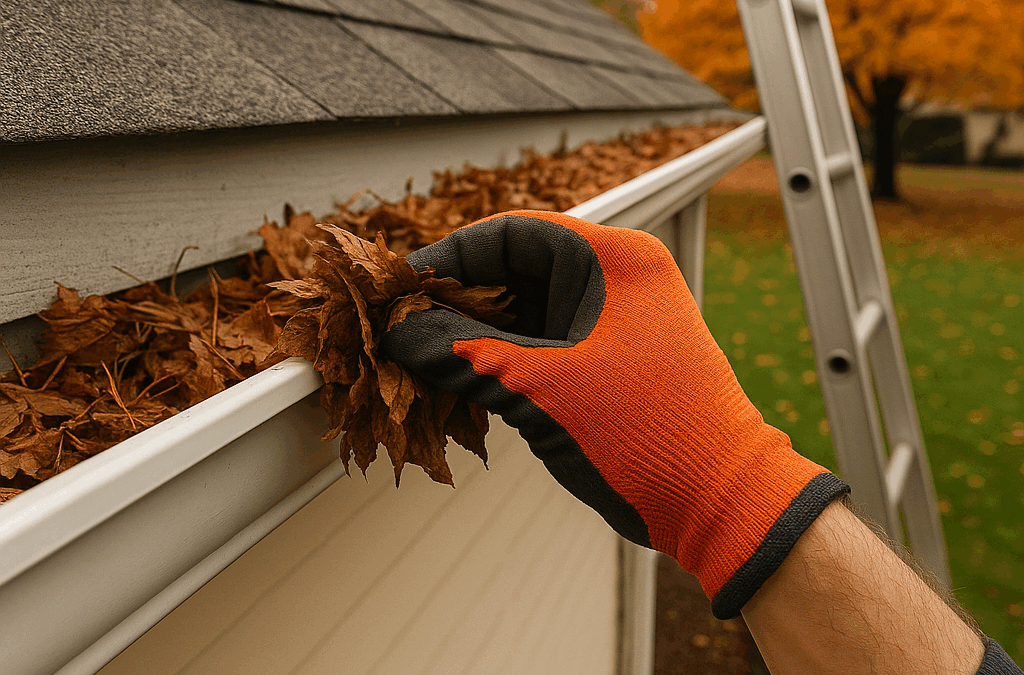
Gutter guards are intended to separate roof runoff from at least some of the debris arriving at the eave. In autumn, that means the debris may collect on the guard surface instead of dropping directly into the gutter. Leaves can also slide away, catch at an edge, or break into fragments small enough to move through openings.
Those outcomes vary across Nashville and Knoxville. Tree species, terrain, roof design, wind exposure, and guard style all influence what a homeowner sees during Tennessee leaf season.
A Guard Changes the Debris Path
An open gutter receives nearly everything that reaches the roof edge. A guarded gutter adds a screen, perforated surface, mesh, cover, or similarly designed barrier. Water and debris meet that barrier before they reach the channel.
Larger leaves may remain above it. Slender needles can align with openings. Acorns and seed pods may roll to a low point or stop behind a twig. Pollen, dirt, shingle grit, and decayed leaf particles can travel with water because they are much smaller.
No single debris pattern applies to every guard. Even the same product may behave differently beneath a steep valley than along a quiet porch eave.
Wet Leaves Behave Differently From Dry Leaves
A dry maple or oak leaf can be lifted by a modest breeze. After rain, it becomes heavier and often lies flat. Overlapping wet leaves can cover a larger area than a loose pile of dry material.
In Nashville, a roof exposed to open wind may shed dry debris quickly between storms. A Knoxville property surrounded by wooded slopes may have sheltered roof sections where leaves remain. These are general influences rather than fixed regional rules; conditions vary from one elevation of a house to another.
As leaves begin to decompose, they lose their rigid shape. Small fragments and dark organic residue may settle into mesh or perforations. A surface that looked covered one week may look clear later even though some fine material has moved into the gutter below.
What Surface Buildup Can Do During Rain
Rain needs an open route through or around the guard. If leaves cover part of the water-entry surface, runoff may spread toward an uncovered section. It may also travel farther across the guard or cross the front edge at a concentrated point.
Storm intensity matters. A light shower and a fast Tennessee downpour do not place the same volume of water on the roof at the same rate. Valleys and intersecting roof planes can focus runoff on a small portion of the gutter, so surface buildup at that location may be more noticeable than debris along a straight run.
From the ground, homeowners might see a thin sheet crossing the gutter edge, several separate drip lines, or water entering normally beside an overflowing section. The observation identifies a pattern, not necessarily the precise cause. Debris, rainfall rate, guard condition, and roof geometry can interact.
Debris Can Exist Above and Below the Guard
The visible leaf layer is only one part of the system. Fine particles may enter the channel and settle where water moves slowly. Material can also gather around a downspout opening or pass into an elbow.
A gutter surface that appears clear from the yard does not verify the condition beneath it. Conversely, leaves resting on a dry guard do not establish that water cannot enter during rain. Watching the system operate offers more information than appearance alone.
Gutter and downspout cleaning addresses material within the drainage path. Removing loose surface debris is a different task. Some guard systems allow access in a particular way, while others use fasteners or sections that should not be pried upward. Manufacturer guidance is relevant before any part is moved.
A Practical Autumn Observation Routine
Inspect from ground level after several dry days. Use binoculars or a zoomed photograph to locate debris near valleys, inside corners, and lower roof sections. Repeat the observation after rainfall to see what shifted and what remained.
During a safe rain observation, compare guarded sections along the same roofline. Note whether water enters across the full length, moves toward one opening, or passes over the front. Also look at downspout discharge, since surface behavior and outlet flow are parts of the same route.
Do not stand beneath runoff or work from a ladder in wet conditions. Gutters are not ladder supports, and sloped ground can add risk around many East Tennessee properties. Cleaning products or tools should not be used on a guard unless they are compatible with its material and finish.
Maintenance-Free and Debris-Free Are Not the Same
Gutter guards may limit the entry of certain large debris, but the roof continues receiving leaves, needles, pollen, seeds, and fine sediment. Some material blows away, some stays on top, and some reaches the gutter.
The useful fall question for Nashville and Knoxville homeowners is how the entire guarded system behaves during actual rain. Seasonal observation can show whether leaves are clearing naturally, forming a wet mat, or concentrating where runoff already arrives quickly. That information is more meaningful than assuming every guard or every roof will respond in the same way.