
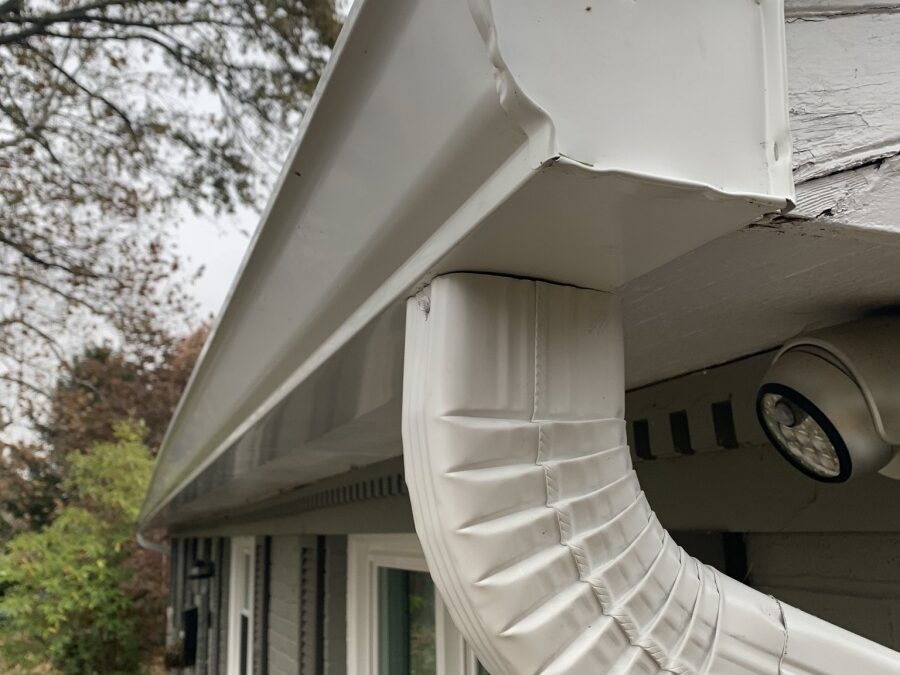
Gutter discoloration is easy to notice on a light-colored roofline. A few gray lines may gradually turn into dark vertical trails, while other sections look chalky, green, or rust-colored. Across Nashville and Knoxville, those appearances can be shaped by rainfall, humidity, tree cover, pollen, sun exposure, and the way roof water enters the gutter.
The color alone rarely identifies the cause. The stain’s position and shape provide better clues about whether it is ordinary surface buildup, an aging finish, persistent moisture, or a drainage pattern.
How Dark Vertical Gutter Streaks Develop
Rainwater does not always fall cleanly from the roof into the center of the gutter. A thin film can wrap around the front lip and travel down the outer face. Along the way, it picks up airborne dust, pollen, roof residue, and decomposed organic material. When the water dries, some of that material stays behind.
Repeated runoff along the same narrow paths can create dark lines commonly described as tiger striping. The marks may stand out after wet weather or become more visible over several seasons. East Tennessee’s wooded terrain and Middle Tennessee’s long pollen season can both add material to exterior surfaces, although individual homes experience different conditions.
Vertical streaking is not proof that a gutter is blocked. It can occur on a clear system when small amounts of water cross the lip. Other signs are needed before connecting the appearance to a flow problem.
Common Types of Gutter Discoloration
Narrow Gray or Black Lines
Lines descending from the upper front edge usually follow repeated water tracks. Their edges may be irregular, and several may appear a few inches apart. These are generally different from a single concentrated stain beneath a corner or connection.
A Dull, Powdery Finish
Exterior coatings change as they are exposed to sunlight and weather. Chalking may give painted aluminum a pale, dusty appearance across a broad area. South- and west-facing gutters can weather differently from shaded sides of the same house.
Green or Patchy Areas
Organic film is more likely on sections that remain damp or receive little direct sun. Homes near dense trees may see patches around downspouts, shaded corners, and lower rooflines. This growth can sit on top of existing dirt or oxidation, producing several colors in one area.
Orange-Brown Trails
Aluminum gutters do not produce iron rust, but steel fasteners or nearby metal can. A rusty streak may therefore originate at hardware, flashing, or another component rather than the aluminum channel.
Staining That Appears With Overflow
Some marks form because water is leaving the normal drainage path. A wide dirty band on the gutter face, drip marks on the fascia, or mud splashes below the roofline may accompany overflow. Inside the channel, leaves, needles, seed pods, shingle particles, and compacted sediment can restrict movement toward the downspout.
Heavy Tennessee rain also matters. A storm can send water toward a roof valley much faster than a light shower does. When marks are strongest below a valley or steep roof section, the pattern may relate to concentrated runoff rather than a uniform issue along the entire eave.
Gutter and downspout cleaning removes debris from the water-carrying parts of the system. Exterior discoloration is a separate maintenance question. Clearing an obstruction may change how future rain moves, but an established stain may remain visible afterward.
What Marks Behind the Gutter Can Mean
Dark lines on the front of a gutter and stains behind it should not be treated as the same observation. Moisture marks on fascia, soffit, or the wall below suggest that water is traveling behind or around the channel. Gutter apron and drip edge are located at the roof-edge transition, where runoff should be directed into the gutter.
A mark below an end cap, miter, or downspout outlet can also point to a localized drip. Wind direction can influence where water appears, so a dry-weather inspection may not reveal the full route. Observing from the ground during rain is often the clearest way to see whether water crosses the front, escapes at a connection, or runs behind the system.
Cleaning Cautions for Painted Gutters
Before trying to remove a stain, identify the surface material and check any available manufacturer guidance. A product that is suitable for bare masonry may damage a painted metal finish. Abrasive pads can change the sheen, and strong chemicals can discolor a coating.
Never mix cleaning products. Some combinations create toxic gases. Test any appropriate method in a small, hidden area and avoid allowing runoff to contact sensitive landscaping. Working from a ladder introduces a separate fall risk, particularly on sloped ground common around Knoxville. Gutters should not be used as a ladder support.
Reading the Whole Roofline
For Nashville and Knoxville homeowners, a useful assessment considers more than the darkest spot. Look for where the mark begins, whether it changes after rain, and whether nearby fascia or soffit is also discolored. Note any standing water, overflow, or slow downspout discharge that can be seen safely.
Thin streaks may be largely cosmetic, while broader water tracks can reveal how rainfall is moving across the roof edge. Oxidation, organic growth, and metal staining have different appearances and may overlap. Understanding those distinctions helps place gutter stains in context without assuming that every mark signals the same condition.